
The Problematic Saint
An essay about my favorite saint and the only real condition of sainthood. I promise it’s universal enough that my Atheist, Muslim, Buddhist, and Hindu friends won’t spontaneously combust from cringe.

Even if you’re not a Christian, you might have heard of the “good thief.”
Tradition calls him Saint Dismas (watch out for a remarkable plot twist: a patron of thieves and prisoners.)
He’s one of the two crucified next to Jesus, sharing His final moments — the one who somehow finds the humility to ask for mercy… or perhaps not even that?
(Seriously: read Luke 23:39–43. It’s super short. I’m curious what you think.)
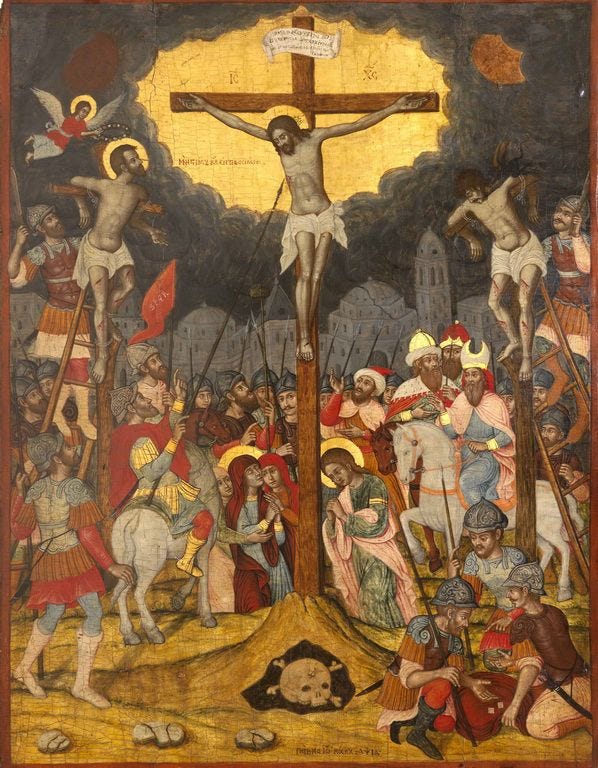
So — why the title? What’s so “problematic” about Saint Dismas?
Let’s begin with this: Dismas is the only person in the entire Bible who gets a direct promise of paradise (and therefore sainthood) from Jesus Himself — “Truly I tell you, today you will be with me in paradise.”
The Church never formally canonized him. He’s recognized as a saint because literally “Jesus Himself said so”. Ironically, without those words, I doubt he’d survive a modern canonization review.
If we boil the Gospel passage down, Dismas does exactly two things:
1. He acknowledges his crimes
“We are punished justly, for we are getting what our deeds deserve.”
It’s honest. It’s sorrow. But it’s not the long-term repentance arc we expect from saints — simply because Dismas doesn’t have a long-term.
His situation assumes a “firm intention to sin no more,” not because he would have certainly become a better man given time, but because he literally cannot sin anymore. (Try committing theft with nails in your hands and feet.)
If you want the theological term, this is called “imperfect contrition.”
What’s unique about Dismas’ story — his confession isn’t to a priest.
It’s straight to God.
2. He turns to Jesus:
“Jesus, remember me when you come into your kingdom.”
You might notice he never says “forgive me”, but he doesn’t need to. “Remember me” means so much more in ancient covenant language.
It translates to: Have mercy. Let me belong. Don’t leave me alone. Don’t let me go.
And… that’s pretty much it. BOOM! Rejoice, people! A saint!
Here’s what Disma doesn’t do (the usual saint cliche):
He does not show heroic virtue throughout his life (he admits how sinfull it was.)
He performs no miracles (unless you consider finding humility one.)
He has no reputation for holiness (quite the opposite.)
He doesn’t offer his life for Christ voluntarily (Rome makes that decision for him.)
There’s something else (note that this is my own reading, not official Church teaching):
I’m not convinced Dismas even recognized Jesus as God.
Fair enough — he says, “Don’t you fear God?” to the other thief.
But soon after he speaks of Jesus as “this man (who) has done nothing wrong”. To me it sounds more like: “This guy? He shouldn’t be here!”
The dual nature of Jesus is the centerpiece of Christian belief, but here we are speaking of a common highwayman, not a theologian. Even the apostles — simple men who spent years with Jesus face-to-face — struggled with this.
Some might say Dismas was a coward (the other thief mocks Jesus until he draws his last breath. What a dope badass, right?)
To me? That makes Dismas human.
His salvation doesn’t hinge on perfect doctrine.
It hinges on trust — raw, instinctive, improvised last-minute prayer.
So what does this mean for anyone wondering about salvation, or, in Christian language, sainthood? (Being in paradise is being a saint.)
Let me answer by explaining why I’m a Christian at all:
We are all sinners.
We are all weak.
We are all helpless against evil on our own.
And yet… every one of us can become a saint — even at the last moment — by turning to God and simply asking for it.
Isn’t that beautiful?
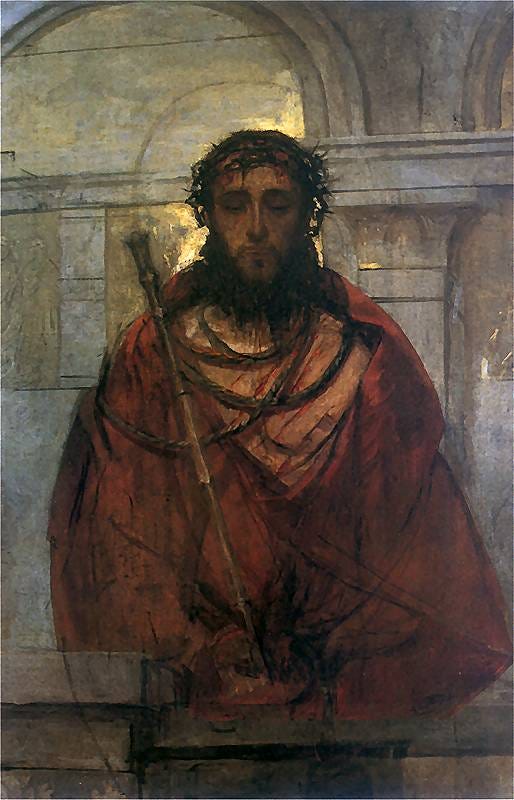
By the way, if you genuinely disagree and believe you’re in full control of your life, sinless, and spiritually bulletproof… please send me your selfie. I’ll frame it and hang it above my bed next to the “Ecce Homo” print. Just write your name so I know which saint I’m praying to.
On multiple occasions I’ve heard my non-Christian friends tell me Catholic “requirements for heaven” are impossible to meet. Ironically enough, my religion says something opposite.
We simply confuse the cause with the effect.
Heroic virtue, miracles, holiness, and martyrdom? They’re not conditions of sainthood. They’re results of trusting God.
Grace precedes virtue. Sainthood begins with admission of weakness, not human perfection. Canonization looks for evidence of trusting God — not the cause of salvation.
This is what I love about Christianity, and why I stay despite all the disgusting failures of the Church, including the ones at the very top.
Last thing: if you’ve ever wondered what “Catholic” means — it comes from the Greek katholikos, “universal.”
In other words: for everyone.
Therefore — no matter who you are, what you believe, what your ethnicity, sexuality, or the weight you carry on your back is — if sainthood is open to everyone, conversation should be too.
So if you’re still here reading this not-so-short essay… let’s connect.
Finding new buddies is my favourite feature of Substack.
As always — thanks for reading, friend.
Write you soon.
P.S. The real name of the “good thief” is unknown. “Dismas” comes from tradition — amusingly, from the Gospel of Nicodemus, an apocryphal text the Catholic Church isn’t exactly fond of.
you know.. I liked this before I even started reading it because I knew it was going to be an absolute banger but I am pleased to say that it deserves much more than a simple button press.
I would consider myself to be the farthest thing from holding any sort of monotheistic faith. I have come to terms with my suffering and in conversation with my friends who are Christian, I have realized that the things that were done to me in the name of "Christianity" were the farthest thing from God.
Your words remind me of my grandpa before he passed away. He was also a Saint Dismas, one that had committed thievery and done bad things over the course of his life. I regard him as one of the best men I met because he knew that all he had to do for forgiveness was, in your words, "simply turn to God and ask for it".
This was an amazing read and makes me feel disdain towards everyone who does not worship God, but the almighty dollar. Above all, it makes me feel love for my Christian friends and those who hold similar faiths. This is what Christianity was meant to be before it was tainted and twisted so many times.
Thank you for this piece.
Sincerely,
A Saint Dismas
THIS WAS SUCH A GREAT READ!!! Personally, I am not Christian, but I have always been interested in the Bible, and exactly these kinds of teaching. I feel like your piece provides such a unique, refreshing perspective on the sainthood, and general universality of Catholicism. It was truly amazing, you are definitely one of my fav authors on here<33